
Relationship Goal Setting for Couples

Imagine building a house without a blueprint or a plan. You buy materials, hire workers, and simply tell them, “Just build my house.” Navigating life and your relationship without clear goals feels the same way. That’s where goal setting for couples becomes essential, especially when you start something new together.
A new year, a new stage in your relationship, moving in together, getting engaged, or making a big commitment–these moments invite reflection and intention, and they’re the perfect time to pause and ask: Where are we going together?
Goal setting isn’t just for fresh starts, though. It’s equally useful when things feel off, when you want improvement in one specific area, or when you simply want more discipline and consistency in your relationship.
Why is Goal Setting for Couples Important?
Let’s take New Year’s as an example. One of the most common traditions is making resolutions to improve what didn’t work before or to start fresh. In fact, this is such a widespread habit that it’s become a core part of modern celebrations, as seen in many popular New Year’s Eve traditions.
Most resolutions, however, are individual: go to the gym, read more books, eat better, save money, etc. What we often forget is to make relationship goals for the new year.
As time passes quickly, you focus on personal goals and suddenly realize you’re spending less quality time together. The house renovation you talked about a year ago never happened. The weekly dates slowly disappeared. Before you know it, small issues turn into miscommunication, tension, or emotional distance.
What Does Couple Goals Mean, Exactly?
Couple goals are shared intentions that guide how you grow together. They can be emotional, practical, financial, or experiential. They’re not about perfection or copying what other couples do, but about deciding, as a team, what kind of relationship you want to build.
Some example of couple goals might include:
- Communicating better
- Managing money as a team
- Spending more time together
- Planning big life changes
- Creating healthier lifestyles
At its core, goal setting for couples is about moving in the same direction consciously.
How to Set Goals as a Couple
Learning how to set goals as a couple can feel overwhelming at first, but the process is worth it. It brings clarity, teamwork, and a sense of “we’re in this together.”
1. Make an “Audit” of Your Relationship 📋
If you’ve ever worked in a corporation, you know that you can’t make a strategy without assessing the current situation first. You look at what works, what doesn’t, and where improvements are needed.
The same applies to couples goal planning. You can’t set meaningful goals without knowing what actually needs attention.
Some couples already know their weak spots because they’ve talked about them many times. Others need a bit more structure to uncover them, and that’s completely normal!
How to do it:
- Make a list of things you want to change, improve, or try in your relationship
- If you’re entering a new stage (moving abroad, adopting a puppy, starting a project together, etc.), list what you want to do, what you don’t want to do, what you expect from each other
- If you’re stuck and don’t know what to add in your list, use reflective questions for couples, journaling prompts, or questions for couples to go deeper into the topics
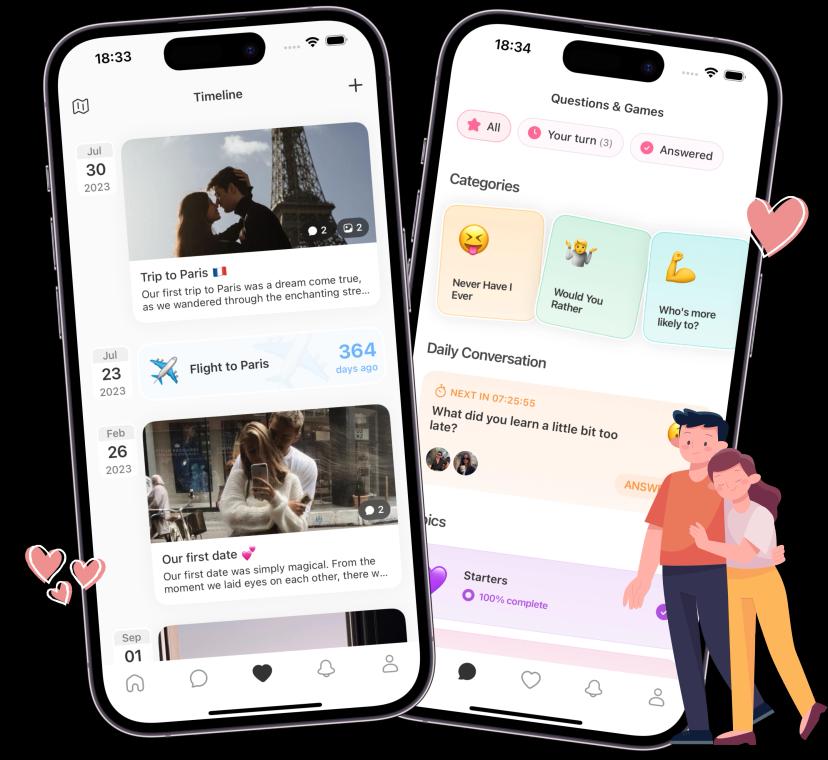
Tip: Use a couple’s app such as CoupleJoy, specifically designed to help couples communicate better and strengthen their relationship. CoupleJoy offers over 3,000 questions, from light to deep, in playful formats like Never Have I Ever, Would You Rather, Who’s Most Likely To, and This or That to make even the most difficult of conversations a pleasant experience. It helps you stay in touch with what you like, dislike, and need in your relationship.



2. Discuss the List With Your Partner 💬
This is teamwork, so communication is essential in this step. This step turns individual thoughts into shared goals.
How to do it:
- Set aside dedicated time to talk
- Go through both lists together
- Remove what feels unnecessary
- Add new ideas
- Notice overlapping goals
- Discuss and negotiate conflicting ones
3. Prioritize What Actually Matters ⚖️
Trying to fix everything at once usually leads to frustration, and too many goals can sometimes harm the relationship as they may feel heavy and create unrealistic expectations. This is why it’s important to prioritize goals and choose the ones that are most important to you.
How to do it:
- You’ll notice that some goals will appear on your list and your partner’s as well. These are usually shared needs and should be the #1 priority.
- Consider urgency and timing. If something happens before another goal, prioritize the one that comes first.
- Decide together what truly matters right now
For example, moving to another country may be more urgent than planning more date nights — at least for the moment.
4. Turn Your List Into Achievable Goals 🎯
This is the step where goal setting for couples goes wrong.
ou’ve made your list, prioritized your goals, and now it’s time to implement them. But as time goes by, you notice that they’re not achievable, and you end up dropping them after a few weeks (sometimes even days).
What went wrong? Many would blame motivation or external factors, but most of the time, the problem lies in the way the goal itself was worded.
When Wording Matters
Let’s take a common goal: “Spend more time together.”
While it’s definitely a goal worth having in a loving relationship, it’s also a bit vague:
- What does “spend more time together” actually mean to you? To your partner?
- Maybe for you it’s an hour a day watching movies on the couch, but for them, quality time might mean doing something interactive where you talk and connect without distractions.
- And then there’s the question of how much “more” really is. One extra hour a day? An extra hour per week? Three hours every evening after work? Or maybe just 30 extra minutes of FaceTime for long-distance couples?
The SMART Framework
This is where the SMART goals framework helps. If you’re interesting in going further into this topic, the University of California provides a great overview of SMART goals, but in short, here’s what it stands for:
- Specific
- Measurable
- Achievable
- Realistic
- Time-bound
You don’t need to be overly technical when it comes to relationship goals, but structure helps.
Example:
Instead of “I want to spend more time with my partner.”, try “Once a week, we’ll have a date (at home or outside) and spend at least 1–2 hours together.”
More examples:
- “Cleaner shared space” ➡️ “Every Saturday morning, we’ll clean the house. I’ll handle the bedroom and bathroom, my partner the kitchen and living room.”
- “Manage finances better” ➡️ “Each month, we’ll both add the same amount to a shared account for household expenses.”
- “Stop fighting” ➡️ “After every conflict, we’ll talk about what triggered it and how to avoid it next time.”
- “Know my partner better” (long distance) ➡️ “Once a week, we’ll try a new long distance date idea.”
- “Travel more” ➡️ “Each year, we’ll take two trips: one summer vacation and one autumn or winter city break.”
5. Track Your Goals and Celebrate Milestones 🎉
Writing goals down significantly increases the chances of achieving them. According to Forbes, this happens through two processes: external storage and encoding.
External storage means your goals are visible and easy to revisit. Encoding helps your brain process and remember them more deeply, demonstrating that writing does make goals stick.
Pen and paper are a good start, but you might lose the paper and then completely forget about the goal. So, why not write it somewhere where both of you have access all the time — just the two of you?
With CoupleJoy’s couple journal, you can write down your goals and make special posts when you achieve them, celebrating every milestone together. Bonus, you can even use the app’s countdown widget for important dates you don’t want to forget!
Relationship Goals Checklist
Here’s a quick relationship goals checklist to keep things simple and always have on hand when setting goals with your partner:
✅ Write a list of things to improve, change, try in your relationship
✅ Talk about lists together
✅ Delete, add, and debate each item on your lists
✅ Prirotize and rank your goals
✅ Use the SMART framework
✅ Write down your goals
✅ Track progress regularly
✅ Celebrate milestones
Goal Setting for Couples Made Easy
At the end of the day, goal setting for couples isn’t about pressure or perfection, but about intention, teamwork, and choosing each other. With the right structure, honest conversations, and a little help such as CoupleJoy, building a relationship with purpose becomes not just possible, but genuinely fun.